Last updated Jul 10, 2026
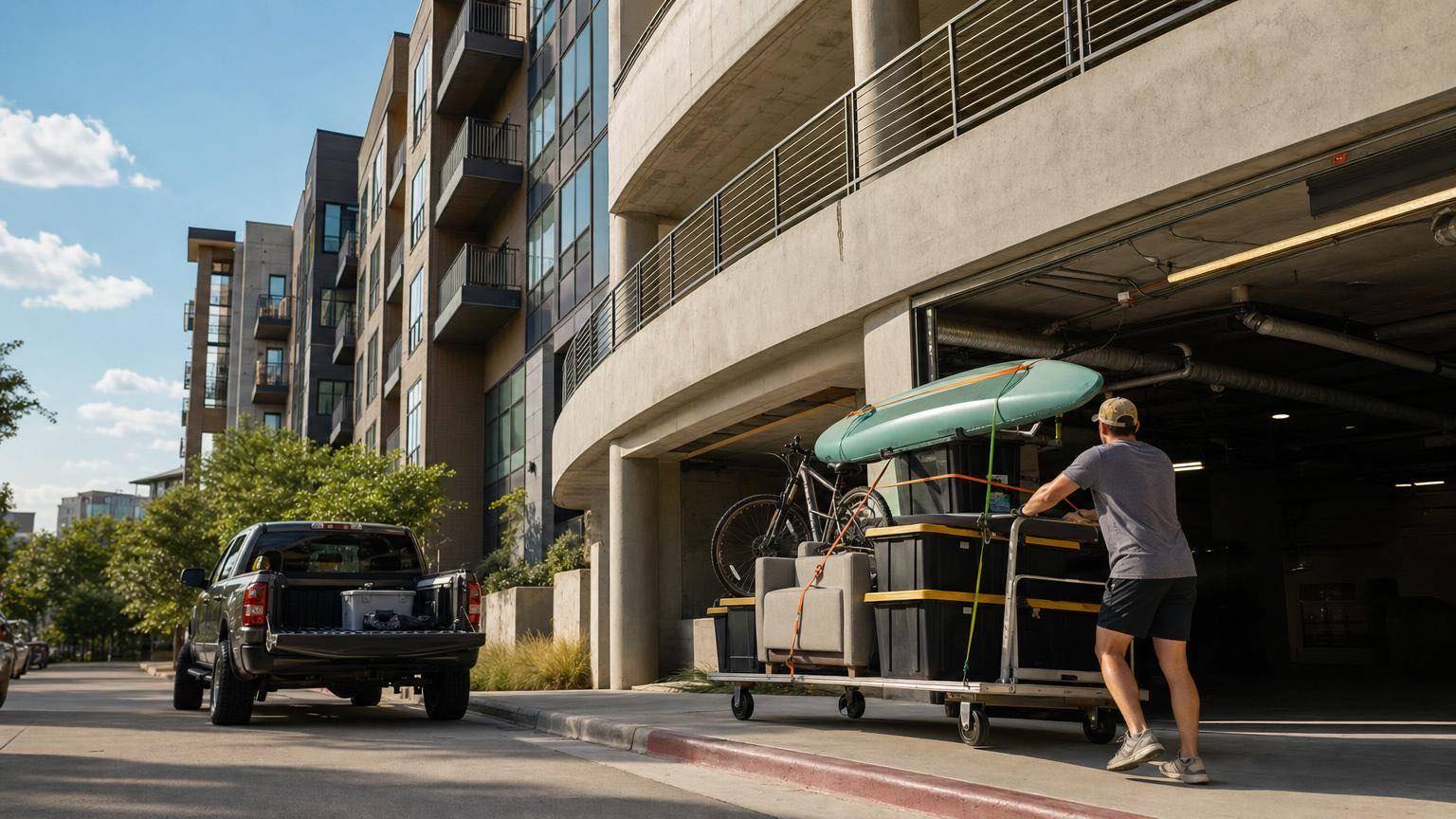
Austin, Texas, represents a unique convergence of lifestyle aspiration and logistical friction. It is a city that markets itself on the promise of outdoor abundance—kayaking on Lady Bird Lake, cycling through the Hill Country, and attending world-class festivals like South by Southwest (SXSW) and Austin City Limits (ACL). Yet, the built environment that houses the city's exploding population is increasingly hostile to the material realities of that lifestyle. The rapid densification of the urban core, characterized by the proliferation of "Texas Doughnut" apartment complexes, creates a specific architectural tension: residents are encouraged to accumulate gear for an active life, but they are housed in structures designed to minimize storage and complicate access.
This comprehensive report serves as the definitive "Storage Survival Guide" for the Austin market. Unlike generic moving advice that might apply to Phoenix or Portland, this analysis is rooted deeply in the hyper-local realities of Central Texas. We examine the specific thermodynamic challenges of uninsulated garage storage in a climate that swings from subtropical humidity to arid heat; the logistical nightmares of moving furniture through 400-foot corridors in mid-rise complexes; and the neighborhood-specific friction of relocating to distinct zones like Rainey Street, Hyde Park, or The Domain.
Drawing on extensive data regarding local urban design, climate impact studies on material degradation, and municipal traffic patterns during major events, this report provides an exhaustive roadmap. It moves beyond simple organization tips to offer a strategic logistical framework for preserving assets and maintaining sanity in one of America's fastest-growing, and most logistically complex, cities.
To navigate the storage crisis in Austin, one must first deconstruct the architecture that creates it. The past two decades of rapid urbanization have transformed Austin's skyline and streetscape. The garden-style apartments of the 1990s have largely been supplanted by higher-density typologies that maximize rentable square footage per acre. While efficient for developers, these designs introduce specific, often severe, pain points for the resident attempting to move goods in or out.
The dominant architectural form of modern Austin multifamily housing is the "Texas Doughnut." This building type is characterized by a multi-story residential structure that wraps completely around a central, concealed parking garage. From the street, it appears as a continuous facade of balconies and windows; from the inside, it functions as a fortress of long hallways and limited access points. While this design allows for high density without the expense of subterranean parking, it creates a unique logistical geometry that penalizes the movement of physical goods.
The most significant friction point in a Texas Doughnut is the extreme distance between the point of vehicular access (the parking garage or loading zone) and the residential unit. In older garden-style apartments, a resident might park within 20 feet of their front door. In a Texas Doughnut, the path of travel is fundamentally different.
Corridor Geography: These buildings often span entire city blocks, with perimeters exceeding 1,500 feet. If a resident's unit is located on the exterior "skin" of the building—often the most desirable units due to street views and natural light—the walk from the central parking core can exceed 300 to 400 feet.
The Multi-Door Barrier: The journey from the car to the unit is rarely a straight line. It typically involves navigating a "gauntlet" of barriers: first, the heavy fire door separating the garage vestibule from the conditioned interior; second, the security-controlled access points; and third, potentially multiple fire doors situated midway down long corridors designed to compartmentalize smoke. For a resident carrying groceries, this is an annoyance. For a resident moving a sofa or a kayak, it is a logistical nightmare.
Implication for Professional Movers: Local moving companies, such as Einstein Moving or MuraWay, operate on hourly rates. In the moving industry, a "long carry" is a standard surcharge triggered when the distance from the truck to the door exceeds 75 feet. In Austin's Texas Doughnut complexes, this surcharge is almost structurally guaranteed unless the unit is fortuitously located adjacent to an elevator bank. The sheer time required to move a single dolly load back and forth across these distances can add 30% to 50% to the total cost of a move.
The vertical logistics of these buildings are equally challenging. In high-density Austin complexes, elevator access is often surprisingly limited relative to the resident population.
The Single Freight Elevator Myth: A common misconception among new residents moving into "luxury" mid-rises in areas like South Lamar or East 6th Street is the expectation of a dedicated service infrastructure. In reality, many of these buildings do not possess dedicated freight elevators. Residents moving furniture must compete for the same passenger elevators used by neighbors walking their dogs or returning from work.
The Reservation Imperative: For high-rise buildings in Downtown and The Domain where freight elevators do exist, they are governed by strict bureaucratic reservation systems. These reservations are often broken into rigid 2-to-4-hour windows. Given Austin's unpredictable traffic—where a trip down I-35 can take 20 minutes or 90 minutes—missing a reservation window is a frequent and costly error. If a mover arrives late, building management may deny access to the elevator to prevent overlap with the next scheduled move, forcing a cancellation or a frantic rescheduling fee.
Dimensional Constraints: The elevators in mid-rise Texas Doughnuts are frequently standard passenger size (roughly 8 feet tall and 6 feet deep). This creates a geometry problem for modern furniture. A standard three-cushion sofa, which might be 84 to 96 inches long, may not fit horizontally. Standing it vertically often requires it to exceed the height of the elevator door frame, and while the interior cab height might be sufficient, maneuvering it in is risky. Professional movers often have to "stair carry" large items in buildings that ostensibly have elevators, adding further to the labor cost.
Perhaps the most overlooked detail in Austin apartment logistics is the vertical clearance of residential parking garages. This is a specific failure point for the DIY mover.
The Height Cap: Most residential parking garages in Austin are designed for passenger vehicles, with clearance heights strictly capped between 6'8" and 7'0". This height is sufficient for a lifted pickup truck but completely prohibits commercial vehicles.
The Rental Truck Reality: The smallest moving truck available from major vendors like U-Haul is the 10-foot box truck. This vehicle has a clearance requirement of approximately 9 feet. Even many cargo vans, such as the high-roof Ford Transit or the Mercedes Sprinter often rented for smaller apartment moves, exceed the 7-foot threshold.
The Consequence: Residents attempting to move themselves often drive their rental truck up to the garage gate, only to discover they cannot enter. This forces a chaotic improvisation: the truck must be backed out (often into traffic), and the entire move must be staged from the street or a distant visitor lot.
The Street Unload: Parking on the street fundamentally changes the nature of the move. It forces the operation to originate from the public right-of-way, which introduces municipal permit requirements. Furthermore, it drastically increases the "Long Haul" distance mentioned above, often doubling the carry time as movers must navigate sidewalks and exterior gates before even reaching the building's interior.
Moving goods in Austin's high-density zones requires navigating a labyrinth of municipal regulations, private security enforcement, and physical constraints. Each district presents a unique "flavor" of logistical friction.
The defining characteristic of moving in Downtown or the Rainey Street Historic District is bureaucracy.
The Loading Dock Mandate: High-rise residential towers (e.g., The Independent, The Austonian, 70 Rainey) operate like commercial fortresses. They have dedicated loading docks, but access is gated behind strict insurance and scheduling requirements. Movers must submit a Certificate of Insurance (COI) listing the building as an additional insured party days in advance. Unauthorized movers (or friends with a pickup truck) will simply be turned away by security.
Street Permitting: For buildings without internal docks—common in older loft conversions or smaller boutique condos—the street is the loading zone. However, you cannot simply park a truck on Cesar Chavez or Congress Avenue. You must "rent" the street from the City of Austin. This involves applying for a Right of Way permit and paying for "meter bagging" to reserve curb space. Costs are significant: a permit to reserve space for a moving truck can range from $200 to over $1,200 depending on the vehicle size (e.g., greater than 26 feet) and the duration of the reservation. Failure to secure a permit risks immediate ticketing or towing, as parking enforcement in downtown is aggressive to maintain traffic flow.
The Domain functions as a "city within a city," but legally and logistically, it operates more like a private corporation.
The "Corporate" Environment: While The Domain feels like a public urban neighborhood, many of its streets and service alleys are privately managed properties. This means municipal parking permits may not apply, and rules are set by property management groups like Simon Property Group.
Loading Zone Scarcity: Despite the extreme density of residential units, designated loading zones for residents are frequently shared with the commercial infrastructure of the district. A mover arriving at 9:00 AM may find the only loading bay occupied by a Sysco food delivery truck servicing a nearby restaurant or a retail shipment for a clothing store. This competition for space creates delays.
Strict Enforcement: The aesthetic of The Domain is carefully manicured, and "unsightly" commercial activity is pushed to the margins. Security is vigilant about unauthorized parking. Leaving a rental truck unattended in a fire lane or a "No Parking" zone to run a box upstairs is a high-risk gamble that often results in towing.
These neighborhoods are defined by their rapid transition from low-density residential to high-density mixed-use, often without the accompanying infrastructure upgrades.
Narrow Streets & Traffic: East Austin's residential streets are often narrow, lined with ditches rather than curbs, and congested with parked cars. Moving a large truck into these areas often requires double-parking or blocking a travel lane, which technically requires a "Right of Way" permit.
Pedestrian Friction: On South Congress, the friction is human. The sidewalks are perpetually crowded with tourists and shoppers. Moving furniture across a public sidewalk on a Saturday is physically difficult and socially awkward. To manage congestion, the city has implemented paid parking zones and stricter enforcement, effectively eliminating the "quick stop" unload. Residents must plan moves for early morning hours or weekdays to avoid the peak pedestrian crush.
New residents often underestimate the destructive power of the Central Texas climate. It is common to hear the complaint, "It's just hot," but for stored goods, the reality is far more complex. Austin sits on a climatological boundary that produces a dynamic cycle of intense heat, variable humidity, and rapid temperature swings. This environment acts as a chemical accelerant for degradation, destroying property in specific, predictable ways.
Austin's climate is characterized by a "wet-dry" cycle that is particularly damaging to organic and composite materials.
Thermal Expansion and Contraction: In an uninsulated garage or an outdoor storage unit, the temperature differential can be extreme. During the summer, the internal temperature of a garage can swing from 75°F in the early morning to over 110°F by late afternoon. This daily swing of 35+ degrees forces materials to expand and contract repeatedly. Over the course of a single summer, this cycle occurs over 100 times.
Effect: Rigid materials with different coefficients of expansion—such as a glass table top in a metal frame, or the glue joints in a wooden chair—are stressed to the point of failure. Joints loosen, adhesives de-laminate, and plastics become brittle.
The Humidity Trap: Austin is not a dry desert; it is humid subtropical. Humidity levels can spike to 90% in the morning hours due to moisture from the Gulf of Mexico and drop to 30% by the heat of the afternoon.
Effect: Hygroscopic materials like wood, paper, and leather act like sponges. They absorb moisture when humidity is high and release it when the air dries out. This constant "breathing" causes warping in wood, cracking in leather, and the catastrophic failure of veneers on particleboard furniture.
Based on the thermodynamic profile of an unconditioned Austin storage space, the following items are classified as "Critical Risk." Storing these items in a garage, shed, or balcony is effectively a decision to discard them.
The garage is a graveyard for modern electronics. The risk mechanism is twofold: heat and condensation.
Battery Degradation: High temperatures are the enemy of lithium-ion batteries. Exposure to temperatures above 85°F begins to permanently degrade battery capacity. A garage that hits 110°F will ruin the battery life of a backup laptop, drone, or cordless drill within weeks.
Condensation and Corrosion: More insidiously, the temperature cycling can cause condensation to form inside devices. As the air cools rapidly at night, moisture can condense on circuit boards. Over time, this leads to the corrosion of copper traces and solder joints, leading to inexplicable device failure.
Solder Fatigue: The expansion and contraction of the different metals on a motherboard (solder, copper, silicon) can eventually cause microscopic cracks in the connections, known as solder joint fatigue.
Much of the affordable modern furniture common in apartments is constructed from particleboard or medium-density fiberboard (MDF) held together with glues and covered in a vinyl or laminate veneer.
The Glue Factor: The adhesives used in this furniture are often heat-sensitive. The sustained heat of an Austin garage softens these glues. When combined with the swelling of the particleboard core due to humidity, the result is delamination—the veneer peels away, bubbles, or cracks.
Structural Disintegration: Unlike solid wood, which might simply warp but remain strong, composite materials can lose their structural integrity entirely. The resin binders can degrade, causing the "wood" to crumble around screws and fasteners. A bookshelf stored in a garage for a summer may collapse under its own weight when moved back inside.
Vinyl records are perhaps the most heat-sensitive item commonly stored by renters.
The Warp Zone: Polyvinyl chloride (PVC) begins to soften and warp at temperatures as low as 140°F. While the ambient air temperature in a garage might "only" reach 105°F or 110°F, localized hot spots—such as inside a cardboard box in direct sunlight or near a metal garage door—can easily breach this threshold.
Pressure + Heat: Even if the temperature does not reach the melting point, the combination of softening vinyl and the pressure of records leaning against one another results in permanent deformation. A vertical stack of records can become a fused, warped brick.
Balcony storage is a popular "hack" for bulky outdoor gear, but in Austin, this exposes items to extreme UV radiation.
UV Destruction: Austin typically has a high UV index. UV radiation breaks down the chemical bonds in the plastic polymers used for kayaks and Stand Up Paddleboards (SUPs). Over time, the plastic becomes chalky, brittle, and prone to cracking upon impact.
Rubber Rot: Bicycles stored on balconies will suffer from "dry rot" on tires, brake pads, and the rubber seals in suspension systems. The ozone and UV exposure accelerates the oxidation of the rubber, rendering the bike unsafe to ride without a full tune-up.
Living in Austin dictates specific storage needs that do not exist in other markets. The "active lifestyle" marketing of apartment complexes—featuring images of residents paddling on the lake or biking the Greenbelt—often clashes with the reality of apartment square footage. Three specific local scenarios trigger acute storage crises.
The proximity to Lady Bird Lake creates a powerful consumer urge to own a kayak or Stand Up Paddleboard (SUP). However, standard apartment architecture is hostile to 10-foot rigid objects.
The Storage Reality: Most apartment leases strictly forbid the storage of large items in breezeways or corridors due to fire code regulations. Balconies are the default option, but as noted in Section 2, the climate risk makes this destructive. Bringing a 10-foot kayak into a unit through a 7-foot door and navigating a "Texas Doughnut" hallway is practically impossible on a daily basis.
The Inflatable Solution: Market research and local forums indicate a massive shift toward high-quality inflatable watercraft (brands like Bote or Intex) for apartment dwellers. These vessels can be deflated, rolled into a backpack, and stored in a closet, effectively bypassing the "hard shell" storage crisis.
Off-Site Storage Racks: For those committed to hard-shell performance, the Texas Rowing Center and various marinas on the lake offer rack rentals. However, demand far outstrips supply, and waitlists can be months or years long. Residents often find themselves paying for a rack they cannot access, leading to the "inflatable pivot."
Austin's weather does not follow a linear winter-to-spring-to-summer progression. Instead, the region experiences a phenomenon locally known as "False Spring"—a period of weeks in late January or February where temperatures hit the 70s or 80s, triggering blooms and the desire to pack away winter clothes. This is almost invariably followed by "Second Winter" or a late freeze in March.
The Logistical Impact: This volatility means residents cannot simply "pack away" winter clothes in a traditional seasonal rotation. A deep storage strategy (moving coats to a remote unit or inaccessible attic) is a recipe for misery.
The Strategy: The Austin wardrobe strategy requires "transitional accessibility." Heavy coats and layers must be kept in "secondary storage"—such as under-bed bins or top-shelf closet space—where they are out of the way but retrievable within minutes. Committing fully to a summer wardrobe before mid-April results in the chaotic unpacking of taped boxes during a sudden 30-degree snap.
Austin's major festivals—South by Southwest (SXSW) in March and Austin City Limits (ACL) in October—are not just cultural events; they are logistical blockades that fundamentally alter the city's traffic and service economy.
Traffic Paralysis: During SXSW, vast swathes of downtown streets are closed to vehicular traffic. Arterial corridors like I-35, Lamar Boulevard, and Congress Avenue become gridlocked.
The Moving Blackout: Attempting to schedule a residential move during these weeks, particularly in Downtown, East Austin, or near Zilker Park, is a strategic error. Professional movers often charge premium "peak demand" rates or may simply refuse service to certain zip codes due to the impossibility of access. Street permits for moving trucks are often suspended or prohibitively expensive during these windows.
Inventory Swell (The Airbnb Effect): A secondary storage trigger during festivals is the "Airbnb displacement." Many Austin residents rent out their apartments at premium rates during SXSW and ACL to offset rising rents. This necessitates a temporary "declutter storage" event, where personal items, valuables, and clutter are moved to a small storage unit or a friend's house for 10 days to make the apartment "rental-ready."
In the battle for square footage in Austin's increasingly expensive rental market, not all items are created equal. Based on the unique constraints of the local architecture and climate, we have categorized common inventory into "Regret Items" and "Active Essentials."
These are items that consistently cause frustration for Austin renters because they either degrade in the climate or consume disproportionate space relative to their utility.
Cheap Particleboard Furniture: As discussed in the climate section, the thermodynamic stress of an Austin garage or a non-climate-controlled moving truck destroys the structural integrity of cheap laminate furniture. The cost of moving a $50 particleboard bookcase often exceeds its replacement value, especially if it arrives at the new location with peeling veneer and crumbled joinery.
Candles in Non-Climate Storage: A box of decorative candles stored in a garage in August will melt into a singular, amorphous block of wax. This often ruins not just the candles but any other items (linens, books) stored in the same box. In Austin, candles are indoor-only items.
Cardboard Boxes: In the Central Texas ecosystem, a cardboard box is food. The cellulose and the glue used in cardboard are primary food sources for silverfish and cockroaches, both of which are endemic to the region. Storing items in cardboard boxes in a garage or shed is an open invitation for infestation. Long-term storage must be migrated to plastic.
Excess Winter Coats: While a good coat is necessary for the few freeze days, storing a massive collection of heavy woolens is inefficient in a climate where they are useful for perhaps 10 to 14 days a year. The "coat closet" in Austin is often better utilized as "gear storage."
Plastic Bins with Gasket Seals: To combat the silverfish and the humidity, the only viable option for long-term storage in a garage or closet is a plastic bin with a gasket seal. This creates a micro-environment that excludes pests and stabilizes humidity.
Transitional Layers: Light jackets, hoodies, and rain gear should be prioritized over heavy parkas. The unpredictable weather means these items need to be accessible year-round, not packed away.
Tech Protection: Any electronics kept in storage must be in a climate-controlled environment. If they must be stored in a garage temporarily, they should be placed inside an insulated cooler (a "poor man's climate control") to buffer the most extreme temperature swings, though this is only a temporary fix.
Storage strategies cannot be generic; they must be tailored to the specific urban fabric of your neighborhood. The logistical profile of a renter in a downtown high-rise is fundamentally different from one in a Hyde Park bungalow.
Here, space is the ultimate luxury. Residents often find that their unit lacks a coat closet or a pantry. The logistical friction is bureaucratic: you cannot simply "move in." You must coordinate with building management, secure permits, and often hire movers who specialize in high-rise logistics. The lack of direct car access means you become a pedestrian shopper—you carry everything from the garage to the elevator to the unit. A high-quality folding wagon is not a luxury; it is an essential tool for survival.
The charm of a 1920s bungalow fades quickly when you realize it was built in an era before modern consumerism. Closets are often shallow, unlit, or non-existent. Residents here must become experts in furniture as storage—beds with drawers, armoires, and trunks. The external threat here is nature: the beautiful heritage oak trees often have low limbs that will rip the roof off a standard moving truck, and the older pier-and-beam foundations are permeable to pests like silverfish.
Living in The Domain offers high convenience but comes with "corporate" constraints. The environment is heavily managed. You cannot leave a muddy kayak on your balcony without receiving a lease violation notice. The parking garages are notoriously tight, often causing "stuck truck" incidents for DIY movers who rent 10-foot trucks that won't clear the 7-foot beams. The "Long Haul" down carpeted corridors is a defining feature of life here.
This curated directory features verified local businesses that solve specific pre-storage and moving problems in Austin. These are not just random Google results; they are selected for their specific utility in solving the friction points identified in this report.
Donation / Junk: For art and craft supplies that Goodwill might reject (like fabric scraps or half-used paints), Austin Creative Reuse is the go-to destination. For large furniture items that are difficult to move, Habitat for Humanity ReStore offers a pickup service, saving you the rental of a truck. For the chemicals you find in the back of your garage (old paint, pesticides), the Austin Recycle & Reuse Drop-off Center is the only legal disposal site, but be aware it requires an appointment.
Movers: Einstein Moving Company is consistently rated for their ability to handle complex apartment moves—navigating the "Texas Doughnut" stairs and elevators without surprise fees. MuraWay Moving is noted for clear communication and efficiency, a solid choice for straightforward local moves.
Cleaning: Boardwalk Cleaning Co. offers a specific "Move-Out" package that targets the areas landlords check most aggressively: inside the oven, the fridge, and the cabinets.
Organization: Moxie Space offers judgment-free decluttering, helping you "edit" your belongings before you pay to move them. For DIY systems, The Container Store (Arboretum) has designers who specialize in retrofitting the small closets of Austin apartments.
Niche Storage: For boat and RV owners, Premium Spaces offers covered and enclosed storage with electrical outlets for trickle charging—essential for protecting batteries in the heat. For wine collectors, Austin Wine Merchant provides expert advice on collection management, while facilities like Bon Vin Wine Storage offer the climate-controlled environment necessary to prevent corks from drying out.
Surviving storage in Austin is not about finding more space; it is about adapting to the space you have and respecting the hostile environment outside your door. The successful Austin renter acknowledges that the climate is an active aggressor against their belongings and that their apartment building was likely designed for density, not easy furniture delivery.
By adopting a strategy of defensive storage (using plastic bins against pests, climate control for electronics), logistical foresight (avoiding festival dates, measuring garage heights), and ruthless editing of inventory, you can navigate the friction of the capital city. The goal is to spend less time managing your "stuff" and more time enjoying the active, vibrant lifestyle that brought you to Austin in the first place.
Everything you need to store your belongings securely, on your schedule.
Visit us online