
The San Leandro Storage Decision Guide: A Comprehensive Analysis of Local Space Management
1. Introduction: The Strategic Management of Space in the East Bay
In the modern urban landscape of the San Francisco Bay Area, space has evolved from a simple commodity into a complex logistical challenge. This is particularly true for the corridor of the East Bay extending from the southern border of Oakland through San Leandro and into the communities of San Lorenzo, Castro Valley, and Hayward. The decision to seek external storage in this region is rarely a spontaneous consumer choice; rather, it is almost invariably a calculated response to a specific structural or transitional pressure. The architectural legacy of the region—ranging from the post-war bungalows of San Lorenzo to the dense infill of Ashland—collides with the accumulation of modern possessions and the evolving dynamics of multi-generational households.
For residents living within the 94577, 94578, 94579, 94580, 94541, 94546, and 94621 ZIP codes, the search for storage is often precipitated by the friction between lifestyle aspirations and square footage realities. The "San Lorenzo Village" home, originally designed for a nuclear family in the 1950s with a single car and modest belongings, now struggles to contain the recreational equipment, home office infrastructure, and inventory of the 2020s economy.1 Similarly, the rapid acceleration of Accessory Dwelling Unit (ADU) construction in San Leandro and Hayward has transformed thousands of garages—historically the de facto storage units of the suburban landscape—into active living spaces, effectively displacing decades of accumulated household goods.2
This report serves as a comprehensive logistical and strategic guide for residents conducting due diligence on storage options near 13760 E 14th St, San Leandro. It moves beyond the superficial metrics of price per square foot to analyze the "hidden" variables that determine the success of a storage experience: the micro-climatic patterns of the East Bay, the traffic engineering that dictates true accessibility, and the neighborhood-specific architectural constraints that influence unit size requirements. By reframing storage not as a static monthly bill but as a dynamic extension of the home, residents can navigate this decision with the same rigor they would apply to a real estate transaction.
1.1 The Geographic and Infrastructural Context
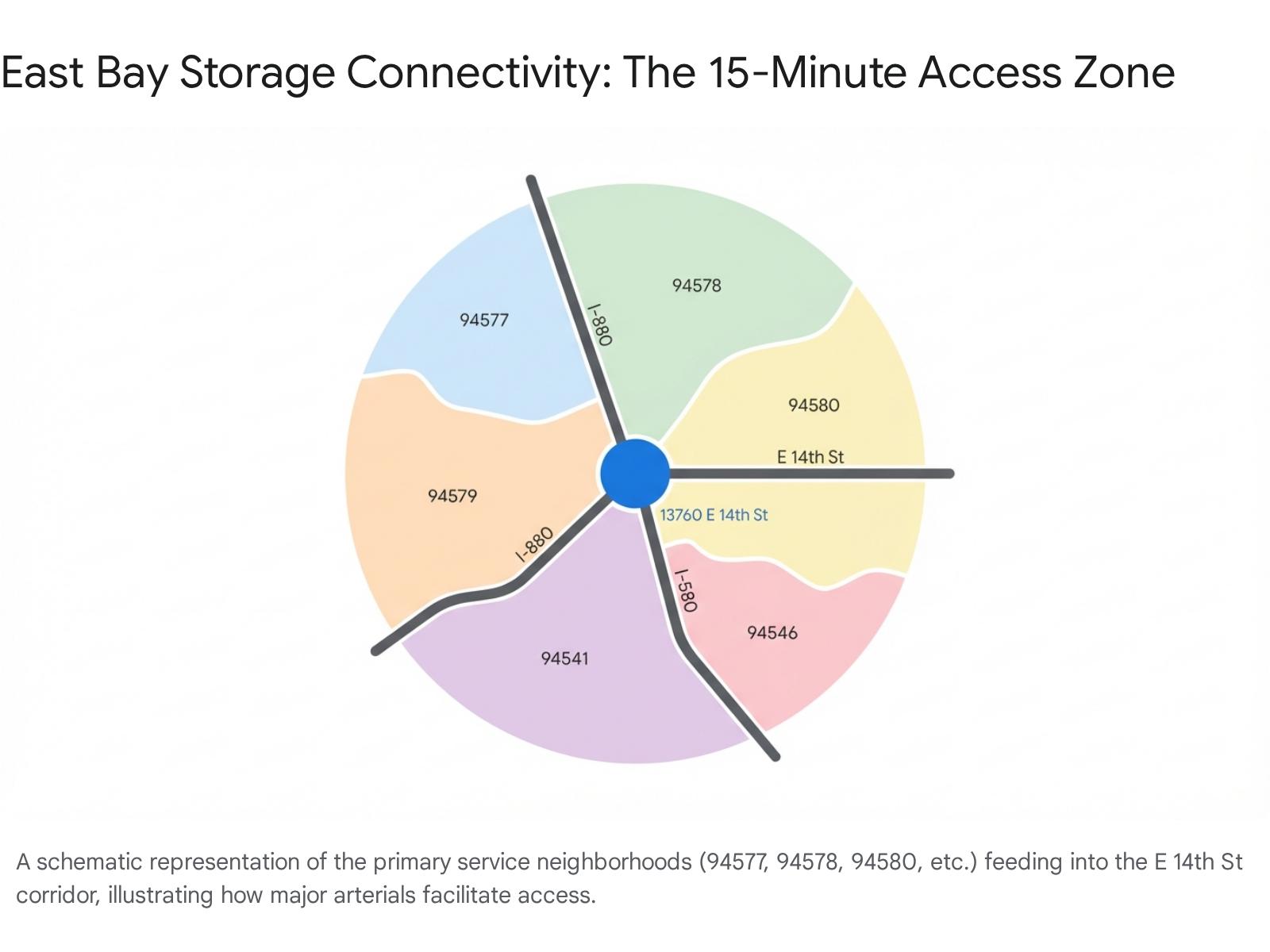
The facility located at 13760 E 14th St occupies a pivotal node in the local transit network. Situated just south of the historic downtown San Leandro business district and in proximity to the Bayfair Center hub, it sits at the intersection of residential density and commercial activity.3 This location is strategic rather than merely convenient. It lies along the E 14th Street / International Blvd corridor, a historic arterial spine that connects the distinct communities of the East Bay without forcing reliance on the often-congested interstate highway system.
For locals, the significance of this address extends beyond its coordinates. It is embedded in the "San Leandro Loop"—the routine pattern of errands that takes residents from the grocery hubs of Washington Manor to the medical appointments at San Leandro Hospital and the retail centers near Bayfair.4 Understanding this context is vital because storage is rarely a primary destination; it is a logistical way station. The utility of a facility is defined by its ability to integrate seamlessly into existing commute and errand patterns, transforming a visit from a burdensome detour into a frictionless stop on the way home.
2. Pre-Search Realities: What Locals Often Overlook
When residents of San Leandro, Castro Valley, and San Lorenzo initiate their search for off-site storage, the initial query is almost always price-driven. However, veteran users of self-storage in the Bay Area understand that the long-term viability of a storage solution is determined by factors that are frequently ignored until the day of the move. The "hidden costs" of storage are rarely monetary; they are paid in time, frustration, and the degradation of goods due to environmental mismatch.
2.1 The Micro-Climate Factor: The Marine Layer and Humidity
The East Bay enjoys a climate that is generally described as Mediterranean, but this broad classification masks a critical local phenomenon: the daily oscillation of humidity driven by the marine layer. This fog belt, which rolls in from the San Francisco Bay over the lower elevations of San Leandro and San Lorenzo, creates a moisture dynamic that is distinct from the dry heat of the interior valleys.5
In neighborhoods closer to the shoreline, such as 94579 (Manor) or the western edges of 94577, the morning fog can be remarkably dense, leading to high relative humidity levels that persist until mid-day. Conversely, the afternoon sun can raise temperatures significantly, creating a cycle of expansion and contraction for materials stored in uninsulated environments.
-
The Logistical Implication: Temperature is not the sole variable of concern; humidity stability is often more critical for the preservation of household goods. While extreme freezing temperatures are rare, the fluctuation between damp, foggy mornings and warm, dry afternoons can be detrimental to sensitive items. Wood furniture can warp, electronics can suffer from condensation corrosion, and archival documents can develop foxing or mold if left in environments that track the external dew point too closely.6
-
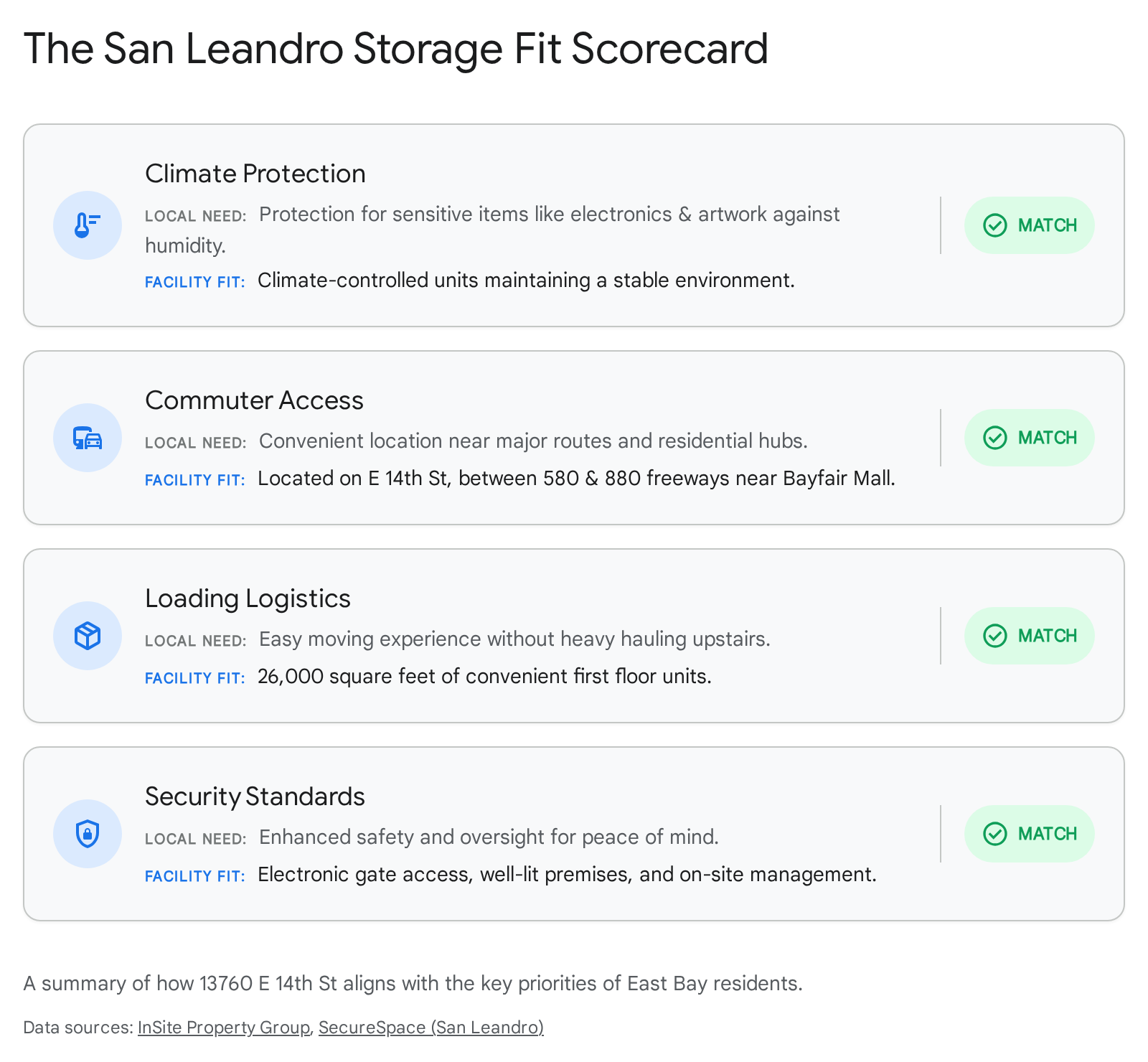
The Strategic Response: For residents planning to store items for a duration exceeding a single season—particularly those living in the "fog belt" west of I-880—prioritizing facilities with climate-controlled options is a defensive necessity. These units typically offer a regulated environment that buffers against the daily and seasonal swings of the local micro-climate, providing a consistent baseline that mimics the interior of a home rather than the exterior of a garage.7
2.2 The "San Leandro Loading" Reality: Narrow Streets and Parking Constraints
A significant portion of the housing stock in the primary service area dates to the pre-war and immediate post-war eras. Neighborhoods in 94577 (Estudillo Estates) and 94580 (San Lorenzo Village) are characterized by their charm and community feel, but also by their infrastructure limitations. Streets in these areas are often narrow, lined with mature trees, and heavily utilized for resident parking. Driveways in the Village, for instance, are notoriously single-width, and many have been encroached upon by landscaping or structural additions over the decades.1
-
The Logistical Implication: Loading a standard 26-foot moving truck in front of a residence in Estudillo Estates is often a logistical impossibility without blocking traffic or navigating complex permit requirements.8 The physical act of moving goods from the home to the truck becomes the primary friction point of the entire process.
-
The Strategic Response: This infrastructural reality shifts the burden of "loading ease" from the residence to the storage facility. If the home environment makes loading difficult, the destination must make it effortless. A facility designed with covered loading bays, wide drive aisles, and ample turning radii becomes invaluable. It allows residents to utilize smaller, more maneuverable shuttle vehicles—such as cargo vans or pickup trucks—to ferry items to the storage unit in multiple trips, rather than attempting to stage a massive load-out curbside at their home. The facility effectively becomes the staging ground that the residential street cannot provide.9
2.3 The "Traffic Shed" Logistics: The I-580 vs. I-880 Dichotomy
San Leandro serves as the convergence point for two of the Bay Area’s most critical, and congested, arteries: Interstate 580 and Interstate 880. While they run roughly parallel, the experience of traversing them—and the surface streets that connect them—is radically different depending on the time of day.
-
The Logistical Implication: For a resident of 94546 (Castro Valley), accessing a facility on E 14th St is a relatively smooth descent via the 580 corridor to 150th Avenue or Fairmont Drive, avoiding the notorious gridlock of the 880/238 interchange. Conversely, for residents of 94541 (Cherryland) or 94578, E 14th St serves as the local spine, allowing for travel north and south without ever engaging with the freeway system. The "cost" of a storage unit in time is measured not in miles, but in the number of traffic lights and freeway merges required to reach it.
-
The Strategic Response: The optimal storage strategy involves selecting a location that integrates with the path of least resistance. For most residents in the primary ZIP codes, a facility on E 14th St allows for surface-street access that bypasses the freeway congestion entirely. This accessibility is crucial during the peak weekday windows of 3:00 PM to 6:00 PM, when local school traffic and commuter overflow clog the major interchanges.10
3. A Practical Decision Checklist: Defining Your Storage Profile
Before committing to a rental agreement, it is essential to move beyond vague estimations and perform a rigorous audit of needs. This checklist is designed to align specific storage requirements with the unique constraints of East Bay living.
3.1 The Volume vs. Floor Space Calculation
A common error in estimating storage needs is visualizing space in two dimensions (floor area) while paying for three dimensions (volume). The verticality of a unit is often the most underutilized asset.
-
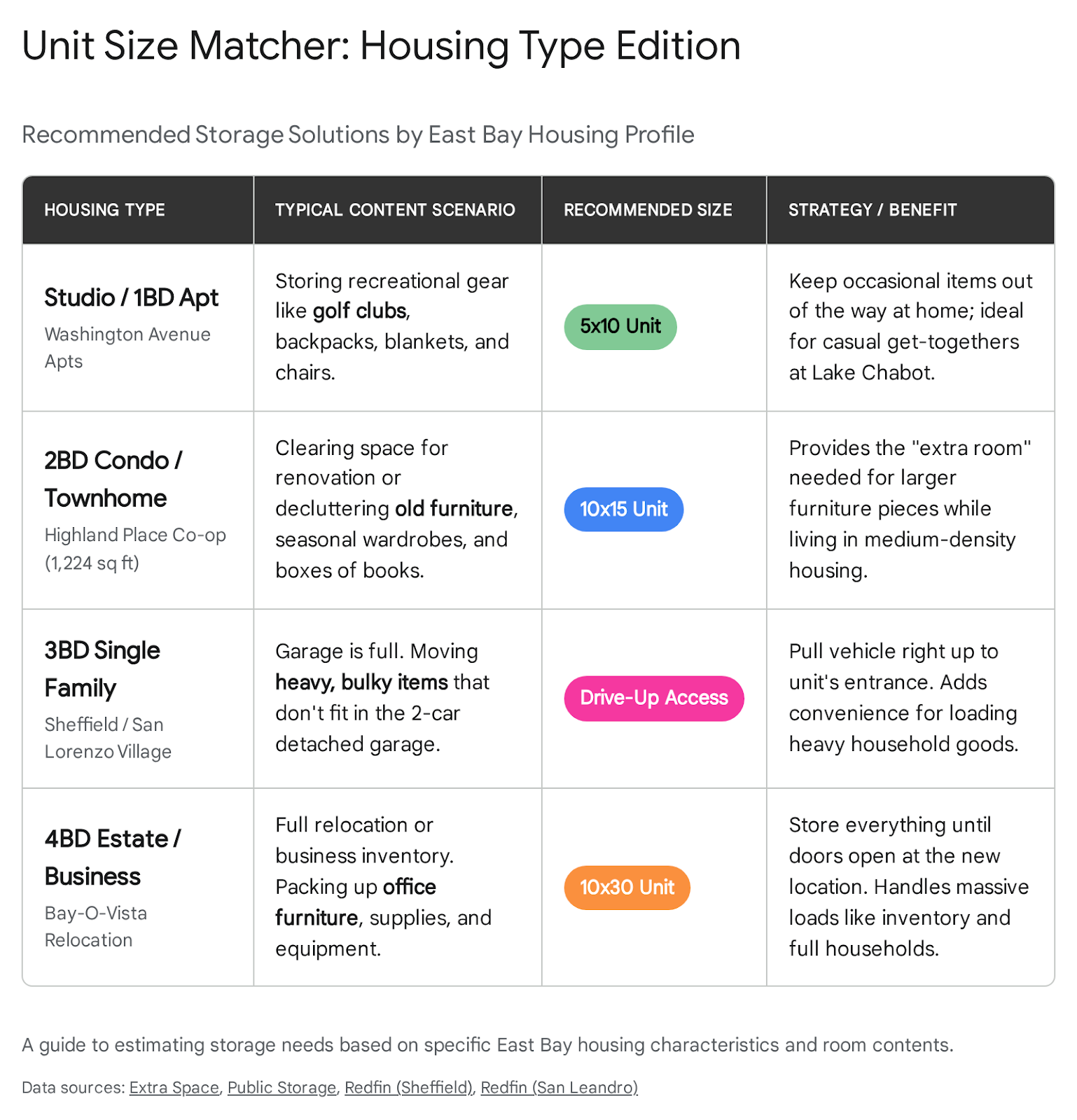
The Apartment Scenario (94578, 94621): Residents in condos or apartments typically possess furniture that is modular or capable of disassembly. For this demographic, a smaller footprint (e.g., 5x5 or 5x10) can be surprisingly sufficient if the vertical space is maximized through shelving or stacking. The constraint here is rarely the size of the items but the density of the pack.
-
The Homeowner Scenario (94577, 94580): Conversely, homeowners are often storing items that defy vertical stacking: lawnmowers, large appliances, heavy heirlooms, or oddly shaped recreational gear. In these cases, floor space is the limiting factor. A 10x10 unit may be required not for the total volume of goods, but to provide the necessary "footprint" for items that cannot be safely stacked.11
3.2 Analyzing Access Patterns
The frequency and nature of access should dictate the type of unit selected.
-
High-Frequency / Active Storage: For a contractor in 94621 needing daily access to tools, or a pharmaceutical representative managing sample inventory, the "friction cost" of the facility visit is paramount. These users require drive-up access or ground-floor units situated near loading bays to minimize the time spent on site. The premium paid for these units is recovered in time saved during daily operations.12
-
Low-Frequency / Deep Storage: For a resident of 94546 archiving tax documents, storing seasonal holiday decor, or preserving family heirlooms, access may be an annual or semi-annual event. In this scenario, an upper-floor unit—often accessible via large freight elevators—is frequently the superior choice. These units are typically more cost-effective and, importantly, offer better protection against dust and street-level debris due to their interior location away from bay doors.13
3.3 The Security Mindset
In a mixed urban environment like San Leandro, security must be viewed as a layered system rather than a single feature. Residents should evaluate facilities based on the depth of their security infrastructure.
-
Perimeter Integrity: Is the fencing substantial and well-maintained?
-
Surveillance Density: Are cameras positioned to monitor not just the entry gates, but also the internal hallways, elevators, and loading areas? Comprehensive coverage is a hallmark of modern security design.14
-
Lighting Strategy: Is the facility illuminated sufficiently to feel safe during the winter months when sunset occurs as early as 4:45 PM? Lighting serves as both a deterrent and a safety feature for users.4
-
Human Presence: Does the facility have on-site management? The "eyes on the street" effect provided by an active office and engaged staff is a powerful, often underrated, component of a secure environment.4
4. Neighborhood Deep Dives: Tailored Strategies by ZIP Code
The "one size fits all" approach to storage is fundamentally flawed in the East Bay because the housing stock, lot configurations, and lifestyle drivers vary drastically from one ZIP code to the next. The following sections analyze how storage integrates into the specific lived experience of the primary service neighborhoods.
4.1 94578 & 94577: The San Leandro Core
The Neighborhoods: This area encompasses the historical and functional heart of San Leandro, including the distinct enclaves of Assumption Parish, Upper Bal, and the highly desirable Estudillo Estates.
The Housing Stock: The architectural landscape here is a rich tapestry of pre-war Tudors, Spanish Colonial Revivals, and mid-century ramblers, interspersed with high-density apartment complexes along the major boulevards.3
The Storage Trigger: Renovation and Preservation.
Owners of the historic homes in 94577 often face a specific preservation dilemma: these houses were built in an era when closet space was minimal and the "three-car garage" was a concept of the distant future. When modern homeowners undertake renovations—whether to open up a floor plan, update a kitchen, or restore vintage details—they are immediately confronted with a lack of swing space. There is simply no "spare room" to absorb the contents of the construction zone.
-
The Strategic Application: For these residents, a facility like the one at 13760 E 14th St functions as the auxiliary wing of the house. During a remodel, a 10x15 unit can easily accommodate the contents of a living room and dining room, protecting antique furniture and soft goods from the pervasive drywall dust and the traffic of contractors. The proximity of the facility allows homeowners to retrieve specific items—a box of files or a winter coat—without planning a major expedition, keeping the disruption of the renovation manageable.
The Urban Dweller: For the apartment residents in 94578, the storage need is often driven by "lifestyle overflow." The Bay Area encourages an outdoor lifestyle—camping in the Sierras, kayaking at the Marina, cycling in the hills—but the 700-square-foot apartments typical of the area lack the capacity to store the requisite gear.
-
The Strategic Application: In this context, a 5x5 or 5x10 unit serves as an external walk-in closet. The key to success here is vertical organization. By utilizing shelving units inside the storage space, a small footprint can hold a surprising volume of gear, making it easy to grab a tent or a bike on a Friday afternoon without navigating a cluttered apartment hallway.
4.2 94580: San Lorenzo Village & The Garden Suburb Challenges
The Neighborhoods: This ZIP code is dominated by the iconic San Lorenzo Village, one of the nation's first planned communities, often referred to simply as "The Village".1
The Housing Stock: The area is defined by thousands of distinct post-war bungalows. While these homes possess immense charm and community history, they were designed for a different era of consumption. Closets are typically small, and garages are often narrow single-car structures that struggle to accommodate modern SUVs.
The Storage Trigger: The Garage Reclamation.
A pervasive trend in San Lorenzo is the conversion or co-opting of the garage. Many residents find their single-car garages filled to capacity with washer/dryer units, water heaters, and workbenches, leaving absolutely no room for vehicles or general storage. Furthermore, the community often has strict standards or HOA-like pressures regarding the parking of RVs, boats, or trailers in driveways.15
-
The Strategic Application: Residents of the Village frequently use self-storage to reclaim the garage for its intended purpose or to convert it into a functional home gym or workshop. By migrating holiday decorations, archival documents, and rarely used tools to a secure facility, the effective square footage of the home is significantly increased.
-
The Local Route: Accessing the facility via Hesperian Blvd to E 14th St is a direct, surface-street route that avoids the freeway entirely. This accessibility makes it feasible to treat the storage unit as an active, integrated part of the home's logistical ecosystem, rather than a remote dumping ground.
4.3 94546: Castro Valley’s Hillside Dynamics
The Neighborhoods: This area is characterized by hillside homes, pockets of Eichlers in Greenridge, and suburban tracts that sprawl into the canyons and upper elevations.
The Housing Stock: Homes here generally feature larger lots and more square footage than in the flatlands, but the terrain presents its own challenges. Many properties are on slopes that make on-site storage sheds difficult to build or access, and driveways can be steep.16
The Storage Trigger: Recreation and Multi-Generational Living.
Castro Valley is a known hub for outdoor enthusiasts who frequent the nearby Lake Chabot and the East Bay Regional Park District trails.11 Kayaks, mountain bikes, camping gear, and other recreational equipment are common possessions, but they consume massive amounts of garage space. Additionally, as families consolidate—with grown children returning home or aging parents moving in—there is often a sudden increase in the density of belongings within the home.
-
The Strategic Application: For "Hill" residents, the drive down to E 14th St is a quick descent via the main arterials. A drive-up unit is often the preferred configuration for this demographic to facilitate the loading and unloading of heavy, awkward recreational gear. This strategy keeps the mud, dirt, and bulk out of the house and garage, preserving the domestic space for living.
4.4 94541: Cherryland & North Hayward Transformations
The Neighborhoods: Cherryland is an unincorporated area known for its unique history as an agricultural hub, characterized by deep lots and a mix of rural and urban characteristics.17
The Housing Stock: The area features a diverse mix of older farmhouses, 1950s infill, and new high-density developments.
The Storage Trigger: ADU Construction and Business Operations.
Cherryland has become a hotspot for Accessory Dwelling Unit (ADU) construction, driven by the generous lot sizes and favorable zoning regulations.2 However, building a "granny flat" or cottage in the backyard often requires the demolition of existing sheds or the clearing out of the primary garage to stage construction materials and equipment.
-
The Strategic Application: During the 6-to-12-month construction cycle of an ADU, a storage unit becomes the temporary warehouse for the displaced contents of the backyard and garage. Once the ADU is completed, the unit often transitions to storing the overflow for the new tenants or family members moving into the secondary dwelling, acting as a permanent "closet" for the ADU.
4.5 94621: The Industrial/Residential Edge
The Neighborhoods: This ZIP code covers the border zone near the Oakland Airport and the Coliseum, transitioning into the industrial parks that line the bay.
The Housing Stock: The residential areas are composed largely of smaller single-family homes and workforce housing, often bordering commercial and industrial zones.
The Storage Trigger: Business Inventory and Asset Protection.
For local contractors, landscapers, and e-commerce entrepreneurs living in this zone, security and access are the primary drivers. The risk of theft from work vans parked on the street is a tangible concern.
-
The Strategic Application: Storing expensive tools, equipment, and inventory at a secure facility like SecureSpace—rather than in a vehicle—drastically reduces the risk profile for these business owners.4 The E 14th St location provides rapid access to the industrial supply houses along San Leandro Blvd and the 880 corridor, allowing for efficient morning load-outs before heading to job sites.
5. Secondary Markets & Commuter Integration
While the primary ZIP codes represent the immediate neighborhood base, the facility's location on a major arterial makes it highly relevant for a secondary ring of users, particularly those in 94579 (Manor) and commuters passing through the corridor.
5.1 94579: The Manor and the Marina Environment
Residents in Washington Manor and the neighborhoods adjacent to the San Leandro Marina face a specific environmental challenge: the pervasive influence of salt air.
-
The Environmental Concern: Proximity to the bay results in higher salinity in the air, which can accelerate corrosion on classic cars, metal tools, and electronics stored in drafty garages or outdoor sheds.5 The corrosive potential of the marine environment is a silent but constant threat to preservation.
-
The Strategic Solution: An interior, climate-controlled unit at the E 14th St facility—located further inland and constructed to modern standards—offers a significantly drier and more stable environment for these sensitive items compared to a backyard shed in the Marina district. It effectively removes the items from the "salt zone."
5.2 The "Commuter Drop-Off" Strategy
For residents who commute from the deeper East Bay to jobs in Oakland or San Francisco, E 14th St (International Blvd) often serves as a critical alternate route when I-880 is congested.
-
The Logistical Logic: Selecting a storage facility along the commute route—rather than strictly near the home—can often yield efficiency gains. For professionals who carry samples or equipment, or for families managing drop-offs at schools along the corridor, having inventory or gear accessible "on the way" prevents the need for time-consuming backtracks. 13760 E 14th St is positioned to serve this "en route" utility, integrating storage into the flow of the daily commute.
6. Common Local Concerns: Addressing the Anxieties of Storage
Researching storage in the East Bay often uncovers a specific set of anxieties. Addressing these concerns directly with factual information allows for a decision made with confidence rather than trepidation.
6.1 "Will my things get moldy?"
This is a valid and pervasive concern in the Bay Area, given the wet winters and the coastal fog patterns.
-
The Reality: Mold requires moisture and stagnant air to thrive. The risk is highest in older, outdoor-access units with poor weather sealing or in facilities located in low-lying areas with poor drainage.
-
The Mitigation Strategy: Modern facilities like SecureSpace typically employ advanced HVAC systems in their climate-controlled sections to regulate humidity, which is the primary driver of mold growth.4 For those renting drive-up units (which are generally not climate-controlled), the recommended strategy involves using desiccant packs (such as DampRid) within the unit and avoiding the use of sealed plastic bags that can trap condensation. elevating cardboard boxes off the concrete floor using pallets or shelving is also a best practice to allow for air circulation.
6.2 "Is it safe to go there at night?"
E 14th St is a busy, urban corridor, and safety is a natural consideration for any facility in such a setting.
-
The Reality: Security is largely a function of visibility, access control, and active management.
-
The Mitigation Strategy: Prospective renters should look for features that create transparency and accountability. Bright, hospital-grade LED lighting that eliminates shadows, electronic gate access systems that log every entry and exit, and high-definition surveillance cameras are the baseline standards for modern security.18 Furthermore, a facility that is impeccably clean and free of debris is a strong indicator of active, attentive management—which is consistently the most effective deterrent against criminal activity.
6.3 "How bad is the traffic to get in?"
-
The Reality: E 14th St is a major thoroughfare and can experience congestion, particularly during the school drop-off and pick-up windows for the nearby San Leandro High School.
-
The Mitigation Strategy: The facility is located on the east side of the street. For those approaching from the north (Downtown/Oakland), access is via a simple right turn, which is seamless. For those approaching from the south (Hayward), there is a dedicated center turn lane. The key logistical advice is to avoid the windows of 8:00–8:30 AM and 3:00–3:45 PM on weekdays to bypass the high school traffic rush. Weekends and mid-day periods typically offer wide-open access.10
7. Why This Location Fits: Alignment with User Behavior
When the marketing language is stripped away, the suitability of SecureSpace San Leandro is determined by how well its physical attributes align with the actual behaviors and needs of the local population. It is not merely about providing "space"; it is about providing usable space that solves specific problems.
7.1 The "In-Between" Spaces
San Leandro is a city defined by its "in-between" nature—situated between the hills and the bay, and bridging the urban core of Oakland with the suburban expanse of the southern East Bay. This facility mirrors that versatility. It offers the drive-up convenience required by the contractor in a rush, while simultaneously providing the climate-controlled protection needed by the archivist in Washington Manor.4 It does not force the user to choose between accessibility and preservation.
7.2 The Modern Infrastructure Advantage
A significant portion of the self-storage inventory in the East Bay consists of converted warehouses or facilities dating back to the 1970s. While functional, these older properties often lack the "creature comforts" that reduce the stress of moving.
-
Elevators and Loading: The presence of large, freight-capable elevators and covered loading bays is a transformative feature.9 For anyone who has attempted to move a sofa during a rainstorm or transport heavy boxes up a narrow flight of stairs, the value of a covered bay and a modern elevator cannot be overstated. It transforms a miserable, physically taxing experience into a manageable logistical task.
-
Hygiene and Cleanliness: New or recently renovated facilities simply have a lower baseline of dust and grime. For residents storing mattresses, upholstery, or clothing, this cleanliness reduces the need for obsessive wrapping and protection, providing peace of mind that items will return in the same condition they left.18
7.3 Supporting the Local Ecosystem
By providing a necessary release valve for the housing pressure in the area, this facility indirectly supports the community's growth and evolution. It facilitates the construction of ADUs in Cherryland by storing displaced items. It allows the historic homes in Estudillo Estates to be preserved and enjoyed without being cluttered by modern excess. It enables the small businesses in 94621 to expand their operations without the burden of renting expensive commercial warehousing. In this sense, the facility acts as a piece of supporting infrastructure for the broader neighborhood.
8. Conclusion: A Decision for Peace of Mind
Choosing a storage unit is rarely the highlight of anyone's month. It is usually a task born of necessity—a move, a death, a birth, a renovation, or simply the realization that life has outgrown the walls containing it.
For residents of San Leandro, San Lorenzo, Castro Valley, and Hayward, the decision ultimately comes down to a balance of trust and logistics. The requirement is for a place that is easy to reach, safe to visit, and capable of protecting belongings from the specific environmental challenges of the East Bay.
SecureSpace Self Storage at 13760 E 14th St addresses these requirements not by making grand promises, but by offering a modern, well-situated, and professionally managed solution. It sits squarely in the flow of daily life, offering a secure extension of the home just down the road. Whether the need is to clear out a spare room for a new arrival, manage a renovation, or store inventory for a growing business, this location offers the "smart," low-stress choice that allows residents to focus less on their possessions and more on living their lives.
Disclaimer: This guide is intended for informational purposes to assist local residents in their research. Specific unit availability, features, and policies should be verified directly with the facility.
Works cited
-
Evaluating the Significance of San Lorenzo Village, A Mid-20th Century Suburban Community - History Colorado, accessed January 8, 2026, https://www.historycolorado.org/sites/default/files/media/documents/2018/si_postwwii_sanlorenzovillage.pdf
-
Accessory Dwelling Units | San Leandro, CA, accessed January 8, 2026, https://www.sanleandro.org/1360/Accessory-Dwelling-Units
-
13760 E 14th Street San Leandro, CA - InSite, accessed January 8, 2026, https://www.insitepg.com/13760-E-14th-St-San-Leandro-CA
-
Best San Leandro Storage Deals Today, accessed January 8, 2026, https://securespace.com/c/san-leandro-self-storage
-
San Leandro Climate, Weather By Month, Average Temperature (California, United States), accessed January 8, 2026, https://weatherspark.com/y/558/Average-Weather-in-San-Leandro-California-United-States-Year-Round
-
Storage Units in San Leandro, CA – Prices from $10 - RentCafe, accessed January 8, 2026, https://www.rentcafe.com/storage-units/us/ca/san-leandro/
-
Find Climate-Controlled Storage Near You in San Leandro, CA, accessed January 8, 2026, https://www.extraspace.com/storage/facilities/us/california/san_leandro/id/climate-controlled-storage/
-
Moving on incredibly narrow streets : r/AskSF - Reddit, accessed January 8, 2026, https://www.reddit.com/r/AskSF/comments/1q5wlcu/moving_on_incredibly_narrow_streets/
-
Best Storage Units Martinez, CA - Secure Self Storage Near You - Rent a Martinez Self Storage Unit Online Today - Clean & Safe Storage Units Near You on Sunrise - Reserve a Storage Unit & Save Up to 50% OFF 1st Month. - SecureSpace Self Storage, accessed January 8, 2026, https://securespace.com/storage-units/ca/martinez-self-storage/4801-sunrise-drive-martinez-ca-94553
-
Driving directions to East 14th Street, E 14th St, San Leandro - Waze, accessed January 8, 2026, https://www.waze.com/live-map/directions/us/ca/san-leandro/east-14th-street?to=place.EiVFIDE0dGggU3QsIFNhbiBMZWFuZHJvLCBDQSA5NDU3OCwgVVNBIi4qLAoUChIJA7X0m9GPj4ARazrw6bUDHZ8SFAoSCa2hRn_UkY-AEaizuJFhMYEr
-
San Leandro, CA, Self-Storage Units Near 14280 Washington Ave, accessed January 8, 2026, https://www.publicstorage.com/self-storage-ca-san-leandro/307.html
-
Business Storage in San Leandro, CA, accessed January 8, 2026, https://www.extraspace.com/storage/facilities/us/california/san_leandro/id/business-storage/
-
SecureSpace Self Storage - 13760 East 14th Street, San Leandro, CA 94578 - StorageCafe, accessed January 8, 2026, https://www.storagecafe.com/storage/ca/san-leandro/securespace-self-storage-13760-east-14th-street/
-
Best Storage Units San Jose, CA - Secure Self Storage Near You - Rent a San Jose Self Storage Unit Online Today - Clean & Safe Storage Units Near You on Winfield Boulevard - Reserve a Storage Unit & Save Up to 50% OFF 2 Months. - SecureSpace Self Storage, accessed January 8, 2026, https://securespace.com/storage-units/ca/san-jose-self-storage/5775-winfield-boulevard-san-jose-ca-95123
-
17.86.210 Recreational vehicles—Use as dwelling—Parked on a private lot, accessed January 8, 2026, https://sanluisobispo.municipal.codes/Code/17.86.210
-
Storage Space - San Leandro, CA Homes for Sale | Redfin, accessed January 8, 2026, https://www.redfin.com/city/17447/CA/San-Leandro/amenity/storage+space
-
Cherryland, CA - Niche, accessed January 8, 2026, https://www.niche.com/places-to-live/cherryland-alameda-ca/
-
SecureSpace Self Storage San Leandro - Reviews, Photos & Phone Number - Updated December 2025 - Packing Services in San Leandro City, Alameda County - Wheree, accessed January 8, 2026, https://securespace-self-storage-san-leandro.wheree.com/
|
Ready to Store? Visit Us Today!
13760 E 14th St, San Leandro, CA 94578
|